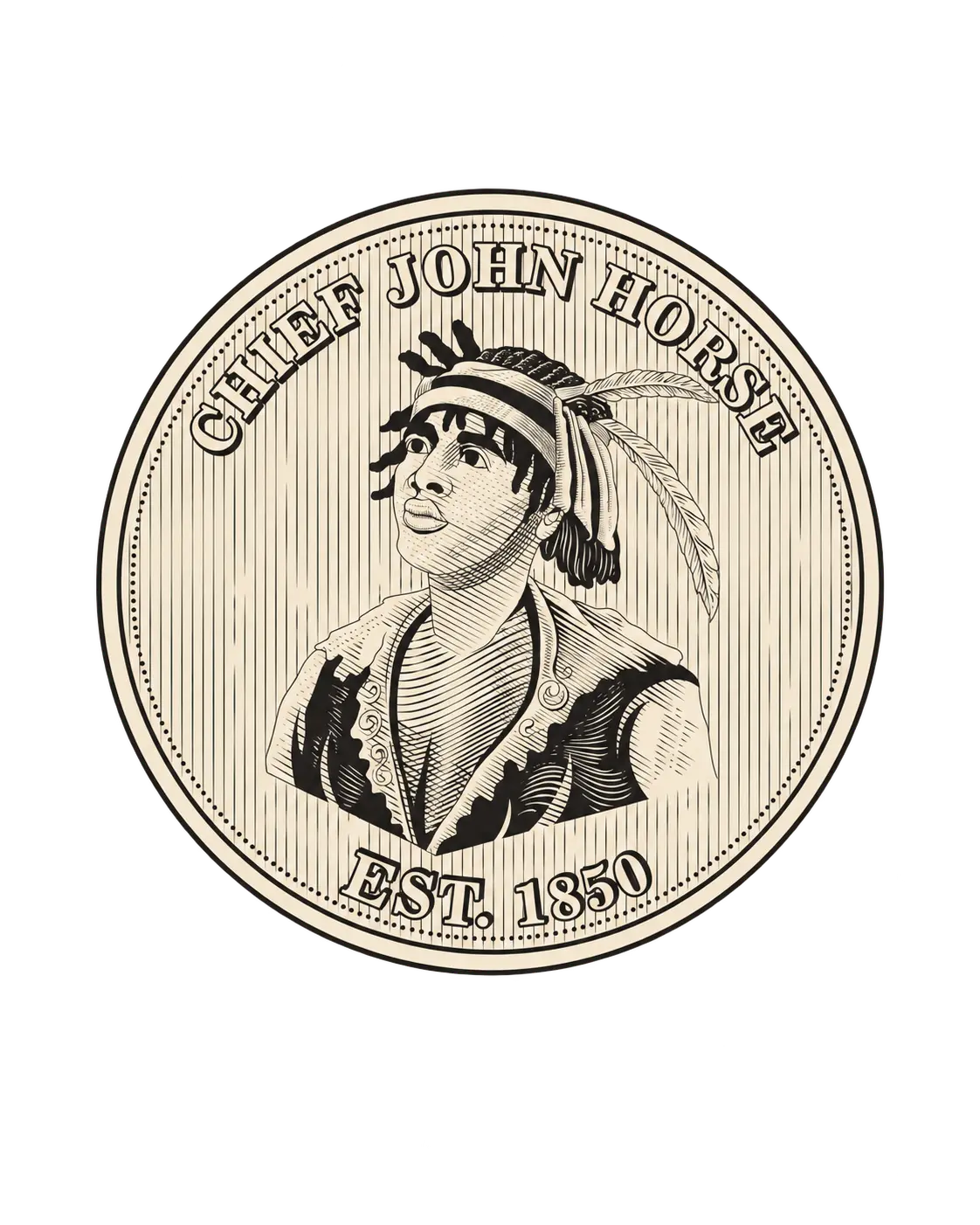
Who Was Chief John Horse?
September 23, 2026
Chief John Horse (c. 1812–1882) was a Black Seminole leader, warrior, and diplomat who spent his entire life fighting for one thing: a free homeland for his people. Born into slavery in Spanish Florida, he became one of the most successful freedom fighters in American history — a man who outlasted the U.S. Army, survived multiple assassination attempts, and led his people across an international border to found a free town in Mexico that still exists today. Almost no one has heard of him. This is the story of why that should change.

A Man of Two Nations
John Horse was born around 1812 in Florida, then held by Spain. His father, Charley Cavallo, was a Seminole trader; his mother was a woman of African descent, held in bondage. From birth, he belonged to two peoples at once — African and Native — and he moved between them with a fluency few could match.
He went by many names over his lifetime: Juan Caballo and Juan Cavallo in Spanish, John Cowaya, and the nickname that followed him for decades, Gopher John. Raised among the Oconee Seminole, he learned to hunt, track, and shoot — earning a reputation as a marksman — but unlike most around him, he also learned to read and write, and he spoke English, Spanish, and the Hitchiti language of the Seminole. That rare combination — warrior and negotiator, fluent across cultures — would define his role for the rest of his life.
The Freedom That Ran South
To understand John Horse, you have to understand a piece of American history that most of us were never taught. For generations, the road to freedom didn’t only run north. For thousands of enslaved people in the American South, it ran south — into Spanish Florida, where Spain offered sanctuary to those who escaped English and, later, American bondage.
Those who made it found more than refuge. Among the Seminole, escaped and free Africans built their own communities, farming, trading, arming themselves, and intermarrying. They became known as the Black Seminoles — allies and kin to the Seminole people, and a standing threat to the slaveholding states to the north. John Horse was born into this world of hard-won freedom. He would spend his life defending it.
War in the Swamps
The United States wanted Florida, and it wanted the people living free there returned to slavery. When the Second Seminole War broke out in 1835, John Horse took up arms. For seven years, a few hundred Seminole and Black Seminole fighters held off the most powerful army on the continent in the swamps and hammocks of Florida — one of the longest and costliest wars the U.S. ever waged against Native and Black resistance.
Horse rose to prominence fighting alongside the legendary war leader Osceola, serving as a fighter and interpreter. In 1837, he was captured along with Osceola under a flag of truce — a violation of the rules of war that outraged even the American public — and imprisoned at the old Spanish fort in St. Augustine. He did not stay imprisoned. In one of the most storied escapes of the era, Horse and the Seminole chief Coacoochee (Wild Cat) broke out of the fort and returned to the fight, meeting U.S. forces days later at the Battle of Okeechobee.
A Promise, and a Betrayal
In the end, the war was not won on the battlefield. It was won with a promise. The U.S. Army offered the Black Seminoles their freedom if they would lay down their arms and move west to Indian Territory. Exhausted and outnumbered, they accepted. Horse himself was granted his freedom for his role in helping bring the long war to a close.
The promise did not hold. In Indian Territory — present-day Oklahoma — the Black Seminoles found themselves placed under the authority of slaveholding neighbors and hunted by slave raiders who saw free Black people as property to be seized. Their freedom, guaranteed in exchange for peace, was worth nothing on paper. Every assurance had been broken.
This is the history behind two words that mean everything to this brand: Honor thy promise.
The Long Road to Mexico

So John Horse did what he had done all his life. He ran toward freedom — and once again, freedom lay to the south. Mexico had abolished slavery in 1829, and across that border, a person could not be owned.
In the autumn of 1849, Horse joined Wild Cat and around a hundred of his people and set out on a punishing journey across Texas, evading slave catchers the entire way. In 1850 they crossed into Mexico. Settling in the northern state of Coahuila, they were eventually granted land at a place that would carry their name and their story: Nacimiento de los Negros — “the birthplace of the Black people.”
In exchange for land, the Black Seminoles — known in Mexico as the Mascogos — served as military colonists, defending the frontier. Mexican authorities recognized John Horse as the undisputed leader of his people and honored him as a captain in the Mexican army: El Capitán Juan Caballo. After a lifetime of war, his people were finally, truly free.
The Last Journey
Freedom still had to be defended. After the American Civil War, many Black Seminoles returned to Texas, where the men were enrolled as Seminole Negro Indian Scouts for the U.S. Army — a unit whose members would earn four Medals of Honor. Horse himself never formally enlisted, serving instead as an interpreter and negotiator, still doing the diplomatic work he had done since he was young.
He remained a marked man. He survived at least one assassination attempt in Texas in the 1870s, and after recovering, he returned home to Nacimiento. Even in his final years, the fight was never finished. When Mexican landowners moved to overturn his people’s claim to their land, the old chief made one last journey — traveling to Mexico City to plead their case before President Porfirio Díaz. He died there in 1882, at roughly seventy years old, still fighting for the promise he had spent his whole life trying to keep.
Why We Remember Him
John Horse never lost his people’s freedom, and he never stopped defending it — across three frontiers, two countries, and seventy years. The town he founded still stands. His descendants still live there. And yet his name appears in almost no textbooks.
A Note From the Founder
I’ll be honest — I’d never heard of Chief John Horse until about eight years ago, when I came across him while researching my own family. I couldn’t stop thinking about him, and I couldn’t understand how I made it all the way through school without ever being taught this. It made me angry, if I’m honest. A man did all of that — and his name isn’t in the books.
I started John Horse Clothing Co. because I could never find a heritage brand that honored a Black American like me. We’ve had Ralph Lauren, we’ve had Tommy Hilfiger — and now we have John Horse, a Black Seminole who chose freedom over surrender. Every piece we make is a small way of keeping a promise this country broke: that his story gets carried forward.
That’s what Honor Thy Promise means to me.
— Gary Sims, Founder · John Horse Clothing Co. · Est. 1850
Back to News